Autonomy‑ready drones built for BVLOS safety and regulatory proof.
Beyond‑visual‑line‑of‑sight operations demand more than a good flight controller. They require predictable behavior, safety‑case thinking, and audit‑ready evidence that can stand up to scrutiny. AuraSpark™ Drone Works develops UAV platforms and autonomy patterns designed to support compliant, defensible operations.
High-level overview only. Detailed, enabling technical disclosures are provided under a mutual NDA.
The problems we solve for BVLOS operations
Safety under uncertainty
BVLOS operations require robust detect‑and‑avoid logic, deconfliction, and fail‑safe behaviors when conditions degrade.
Compliance‑ready evidence
Operators need telemetry, logs, health monitoring, and decision traces that support oversight and post‑incident review.
Field‑reliable sensing
Autonomy depends on clean inputs. We emphasize stability and platform design choices that protect sensor clarity.
Program pillars
Proprietary drone platform
A patent‑pending multirotor airframe designed to stay compact without accepting the typical efficiency and hardware compromises of common designs. Public details remain high-level until patent publication.
Sense → Think → Act → Audit
An autonomy stack built to produce evidence: what the vehicle saw, what it decided, what it did, and why. Built on the same AURA (Autonomous Unified Reliability Architecture) constraint enforcement and audit infrastructure as AuraSpark’s DoD AI governance product—auditability is architectural, not bolted on.
Part 108 readiness
Safety case, CONOPS, and operational artifacts aligned to the FAA Part 108 BVLOS NPRM so deployment is defensible.
Powered by PIHCE: Unlocking True BVLOS
True Beyond Visual Line of Sight (BVLOS) and swarm operations require more than just reliable hardware—they require verifiable software governance.
AuraSpark drones are governed by our proprietary PIHCE (Provider-Independent Hierarchical Constraint Enforcement) architecture. PIHCE acts as an inviolable, hardware-rooted safety envelope. It intercepts all autonomous flight commands before they reach the flight controller, evaluating them against strict cryptographic constraints (such as absolute geofencing and collision avoidance protocols).
If the onboard AI encounters an edge case or attempts an unapproved maneuver, PIHCE instantly blocks the action, logs the anomaly, and triggers a deterministic safe state. This is how AuraSpark is building the safety case required for complex FAA Part 108 compliance.
How we build
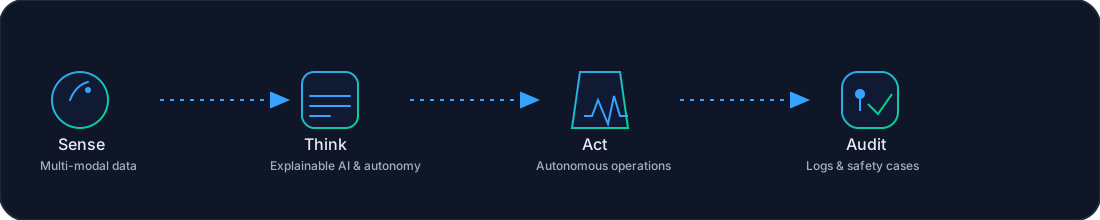
Sense
Multi-modal sensing and telemetry for real-time situational awareness and evidence capture.
Think
Transparent decision logic, constraints, and safety guardrails designed for reviewability.
Act
Operational actions with fail-safe behaviors, human oversight hooks, and clear state reporting.
Audit
Structured logs and artifacts to support compliance, safety cases, and post-flight reconstruction.
Engage
Operators & pilots
We’re interested in early operator partnerships to shape real CONOPS and measurable success criteria.
Test ranges
Range collaboration and scenario-based testing to validate behavior under edge cases and degraded conditions.
Integrators & OEMs
Payload, sensing, and autonomy integration discussions (including licensing) under NDA.